Okay, So What’s Up With Greenland?
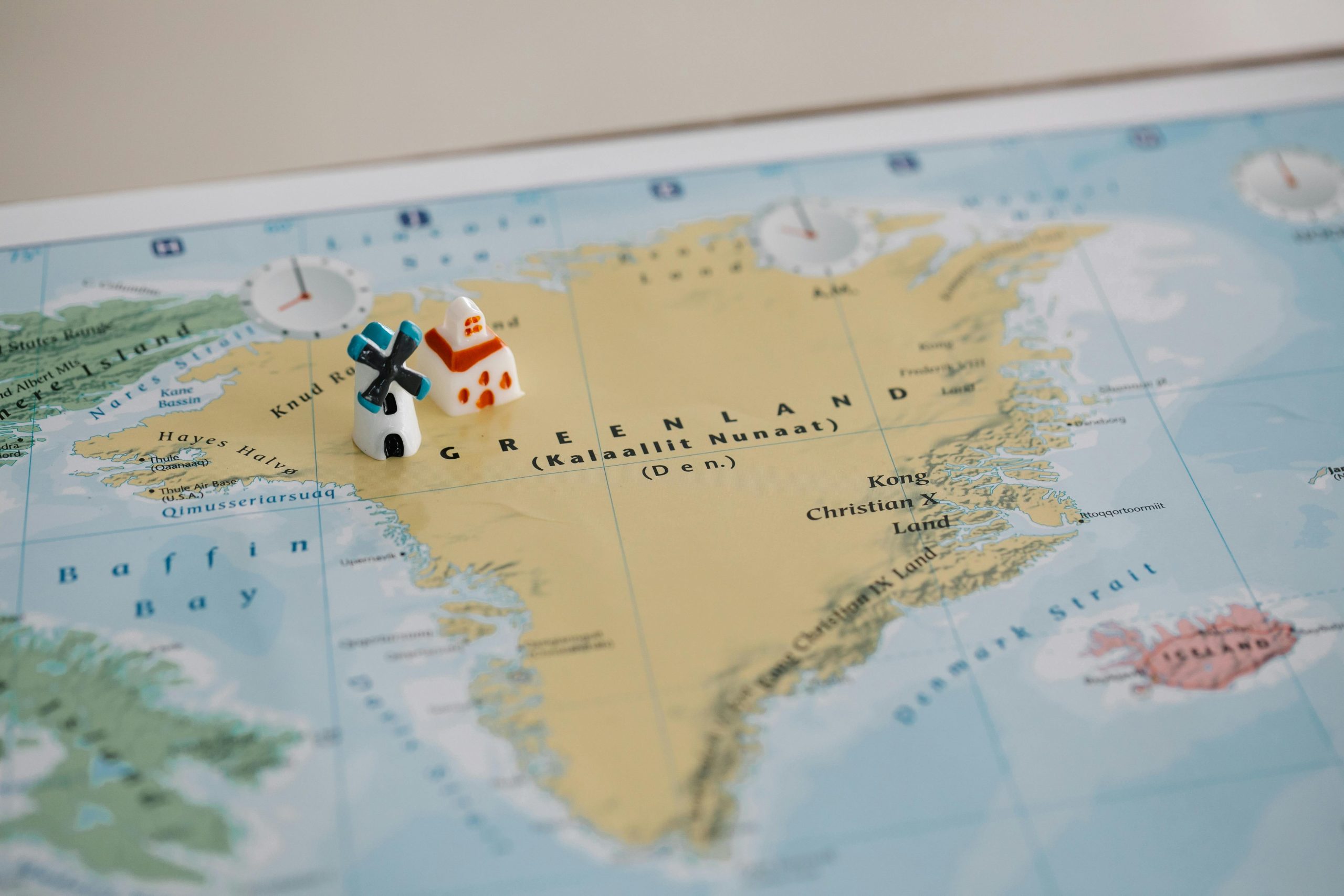
Greenland, the useless piece of whiteness that looks way bigger on a map than it actually is. The mystic island that keeps countless secrets hidden under the ice, a country never talked about until recently. Although Greenland has come up so much in the news the past months, it doesn’t really resonate how this recently-proclaimed boring and useless country gets so much attention all of a sudden. What has happened? And how has Greenland been able to situate itself exactly in the centre of all global news the last months?
You probably haven’t missed the red lines of this heated topic, anyways, since it has been in the news a lot: Donald Trump, the recently inaugurated president of the United States, has tried to get a firmer grip on Greenland and wants to eventually make it a part of his own country. And he certainly hasn’t done this in a nuanced way. He plans to “get it, one way or another.” His interest isn’t simply for no reason: Greenland’s natural resources have shown to be a major factor of interest. Due to the changing climate, many more resources on the island have become reachable as much of the permanent ice has started to melt. However, natural resources are merely a fraction of interest expressed by the major power, as Greenland’s position in the north proves to be beneficial for nuclear weapons, since it is the closest location to western Russia. The potential North American enemy is, among others, showing interest in militarizing the arctic north. China and Russia are both increasingly building on arming arctic northern regions, which builds pressure for the US to similarly find territory in the north to enforce the country’s defence force.
What is interesting about Trump’s reasoning surrounding this discussion, is that he is urging the population to make a decision about which country they want to belong to, while simultaneously stating that he will get the island, one way or another. Greenland’s population is small, with about 56.000 inhabitants consisting mostly of Inuit communities. Thus, it is typical that Trump claims to stand up for the population of Greenland, but actually ignores their wants and needs. The Prime Minister of Greenland has already expressed that the people of Greenland want to remain part of their own country. Though Greenland is not a fully sovereign nation, it does still consider itself a distinct part from Denmark.
Denmark’s response to the President of the United States has been fierce, with Prime minister Mette Fredriksen making it clear that Greenland is not for sale. She has proclaimed that the choice lies in the hands of the people of Greenland themselves, and that it is their sole decision to make. As the same sentiment can be seen with the people of Greenland, one could speculate that a referendum would result in the formation of a sovereign nation of Greenland. Part of their wish for independence is due to the uncomfortable past with Denmark, as the state hasn’t always acted in an ethical way towards their arctic citizens. Many scandals have made clear the uneven relationship between Greenland and its sovereign ruler. During the twentieth century, children were taken from households to be re-educated in Denmark, for them to return as the “model-citizens” in Greenland. What’s more, the “spiral case” was a project from the Danish government to force Inuit women and girls to have contraceptives like IUDs so that population growth would stagnate, which is another good reason for the people of Greenland to decide that they want to break formal ties with Denmark. It is thus understandable that Greenland wants to break its ties with their ruler. Unfortunately, the economic dependence on Denmark and the increasing geopolitical interests expressed by several global great powers might make a tentative to independence unwise. With a population of 56.000 people, it will become difficult to establish a worthy opponent against potentially looming predators, such as the US or Russia. Still, the wish for Greenland’s independence is more than just seeing how they, once again, experience negative encounters with sovereign states that take a completely ignorant stance towards their wishes. Furthermore, the chances of a potential military threat against Greenland is still slim, as the principle of inviolable borders still presumably has some value for the US, and Russia and China would have to seriously consider attacking a country that has so many western ties.
I think that news broadcasters who are already tired of Greenland will have a hard time in the future, because it seems like there is still a lot to happen in and around the snowy, isolated and (un)popular island. There have already been speculations about a referendum for the population of the country to decide whether they want independence from Denmark. While no one knows what the actual outcome would be, it is clear that if that happens, the people of Greenland will not be the only ones holding their breath.